
Blog

A real leather jacket is made from animal hide that has been tanned and finished. A faux leather jacket is made from a synthetic coating, most often polyurethane (PU) and sometimes PVC, applied over a fabric backing and usually embossed to look like leather grain. The practical differences show up in how each material feels, ages, wears, handles moisture, and what it costs.
Neither is automatically the right choice. Real leather tends to suit buyers who want long-term ownership and a jacket that changes with wear. Faux leather tends to suit buyers who want a lower entry price, a lighter feel, an animal-free material, or a trend-led piece they will wear occasionally. Quality also varies a lot inside both categories, so a well-made faux jacket can outperform a poorly made real one.
This article compares the two on durability, feel, appearance, aging and patina, maintenance, water behavior, weight, price, environmental considerations, and who each material suits. For a broader look at leather types, jacket styles and fit, see our Complete Leather Jacket Guide. Here we stay focused on the real-versus-faux decision.
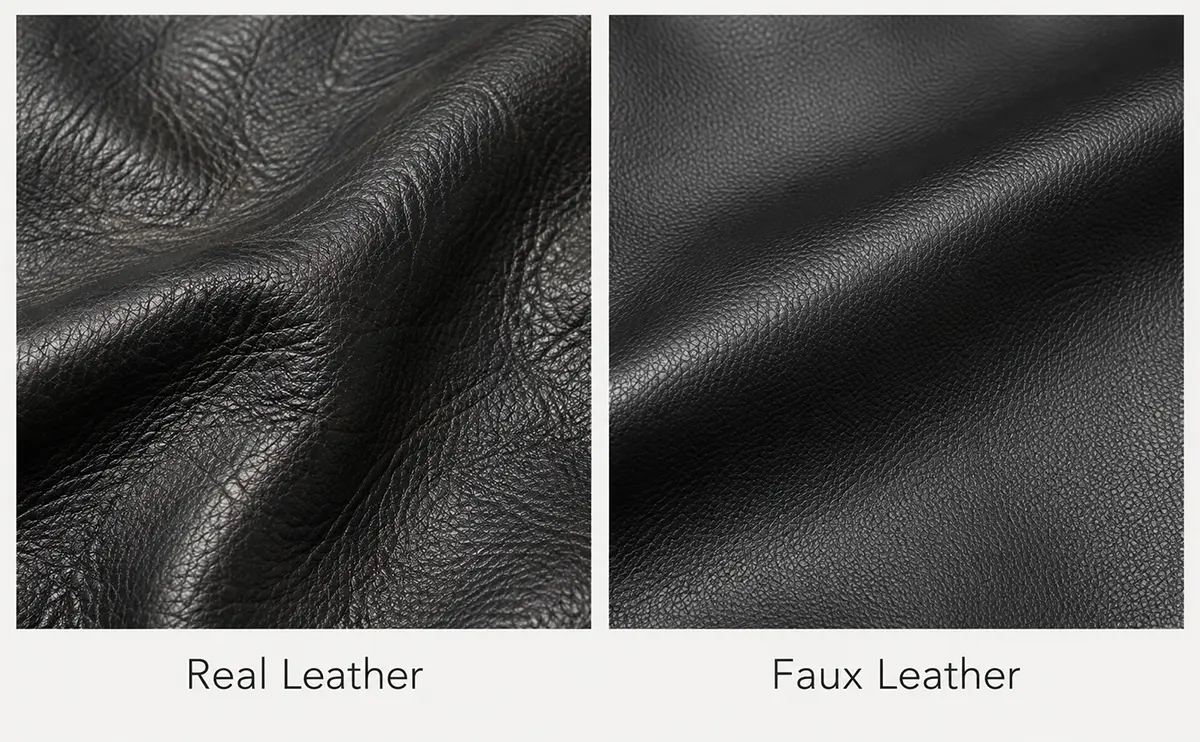
Real Leather vs Faux Leather at a Glance
| Feature | Real Leather | Faux Leather |
|---|---|---|
| Material | Animal hide | Synthetic-coated fabric |
| Feel | Natural, varies by hide | More uniform |
| Durability | Often higher if well made | Varies widely, often shorter-lived |
| Aging | Softens and changes with wear | Usually wears through the coating rather than developing patina |
| Patina | Can develop | Does not develop true leather patina |
| Maintenance | Needs material-appropriate care | Usually easier to wipe clean |
| Water behavior | Some resistance, not waterproof | Surface may resist light moisture depending on coating |
| Weight | Varies, often heavier | Often lighter |
| Price | Usually higher | Usually lower |
| Appearance | Natural variation | More uniform |
| Animal-derived | Yes | No |
These are general tendencies. Construction, material grade and finish matter in both categories.
What Is Real Leather?
Real leather is animal hide that has been tanned, a process that stabilizes the hide so it does not decompose and stays flexible. Jackets are commonly made from cowhide, lambskin, goatskin or sheepskin, and each behaves differently. Lambskin is typically soft and light. Cowhide is typically firmer and heavier. Goatskin sits somewhere between.
Real leather also comes in different constructions of the hide itself, such as full-grain, top-grain, corrected-grain and split leather. We cover those in depth in the Complete Leather Jacket Guide, and the most common jacket-specific comparison in Cowhide vs Lambskin.
The key point for this comparison: “real leather” is not automatically a mark of high quality. The quality of a real leather jacket depends on:
- the type and grade of hide
- thickness and consistency
- the tanning method
- the surface finish
- how well the jacket is constructed and stitched
- the lining
- the hardware, such as zips and snaps
A thick, well-finished hide in a carefully made jacket is a very different product from thin, heavily corrected leather in a rushed one. Both are “real leather.”
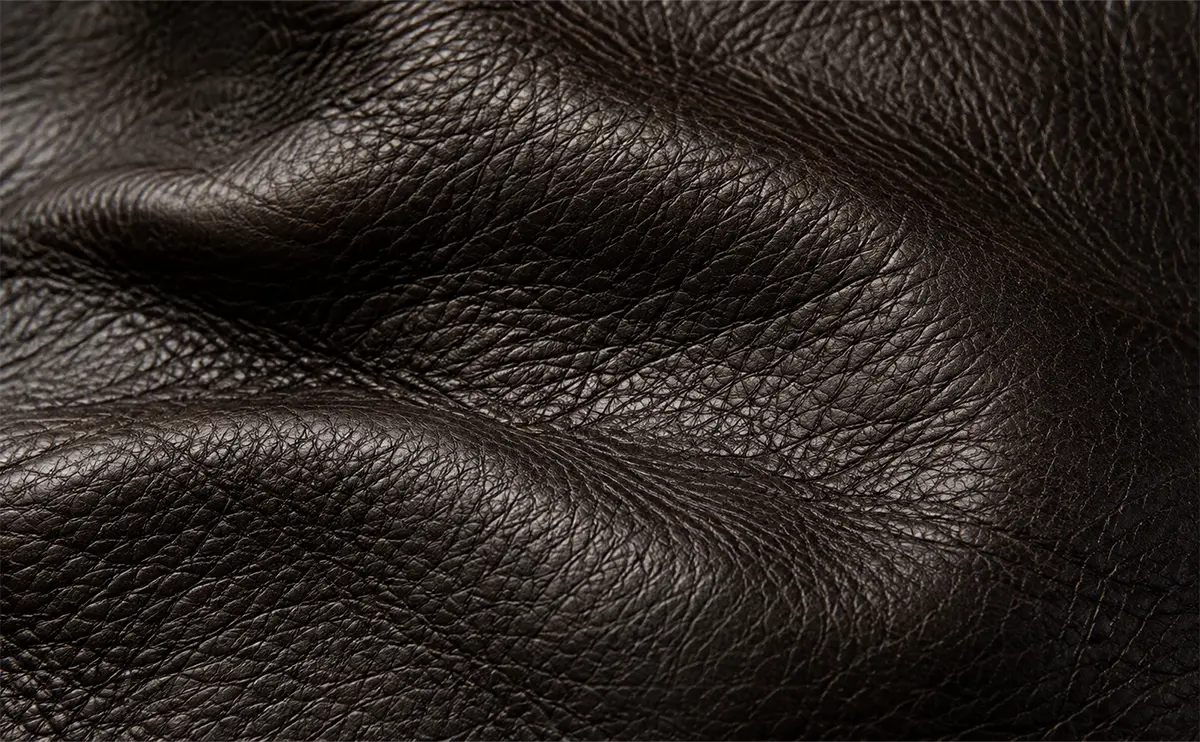
What Is Faux Leather?
Faux leather is a synthetic material made to imitate leather. It is not animal hide. Most faux leather is built in layers: a fabric backing (often woven or knitted polyester or cotton blends) with a polymer coating on top. The coating is usually embossed with a grain pattern so the surface resembles leather.
The two coatings you will see most often are polyurethane (PU) and polyvinyl chloride (PVC). PU is the more common choice in modern fashion jackets because it can be thin, flexible and relatively soft. PVC tends to be stiffer and is more often seen in other products.
Is PU Leather the Same as Faux Leather?
Not exactly. Faux leather is the broad category. PU leather is one common type within it.
So a PU jacket is a faux leather jacket, but not every faux leather jacket is PU. PU is popular in fashion outerwear because it can be lightweight, flexible and cost-effective to produce. That said, PU products are not all equal. Coating thickness, backing fabric, how the layers are bonded and how the surface is finished all affect how a jacket looks, feels and lasts. Treat “PU” as a description of material type, not a quality guarantee.
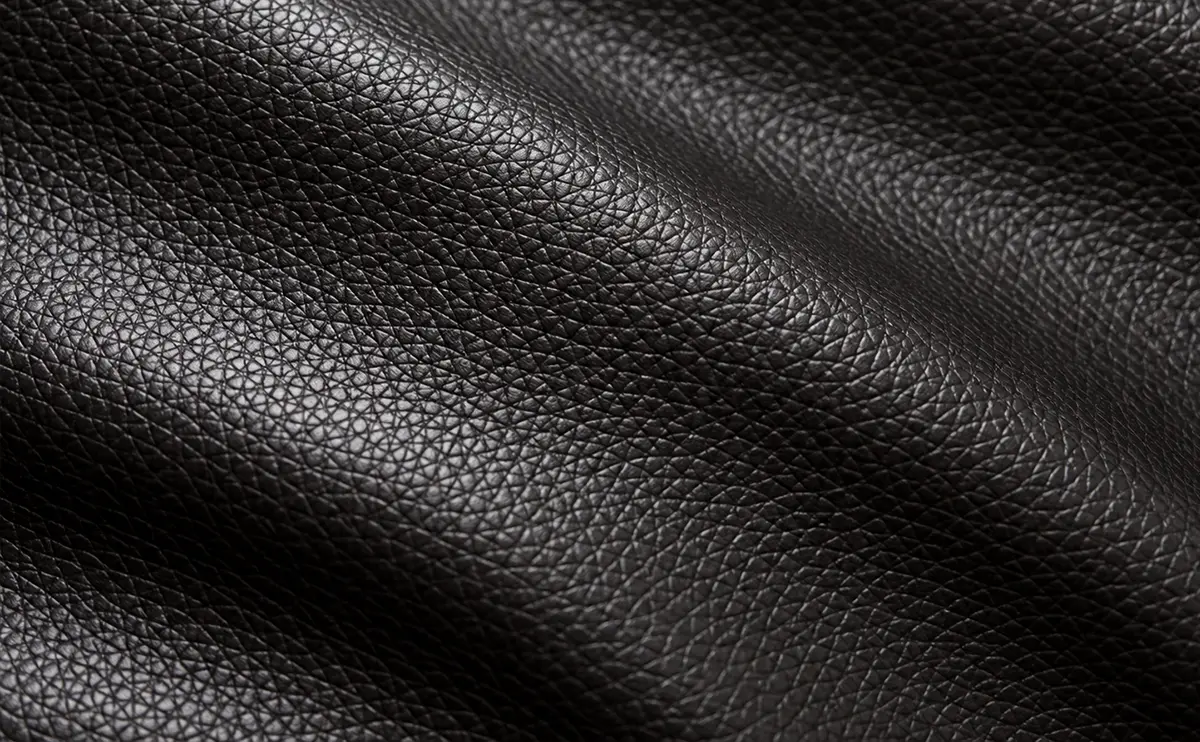
Real Leather vs Faux Leather: Durability
Durability is usually the deciding factor for people who plan to wear a jacket often, so it deserves a careful look.
Real leather
A well-made real leather jacket can last many years with reasonable care. Leather is a fibrous natural material and generally handles repeated flexing and creasing well. In many cases, leather can be conditioned or professionally repaired, which extends its life further. Still, quality varies. Thin or heavily surface-treated leather can scuff, dry out or crack, and poor stitching or weak linings can shorten a jacket’s life regardless of the hide.
Faux leather
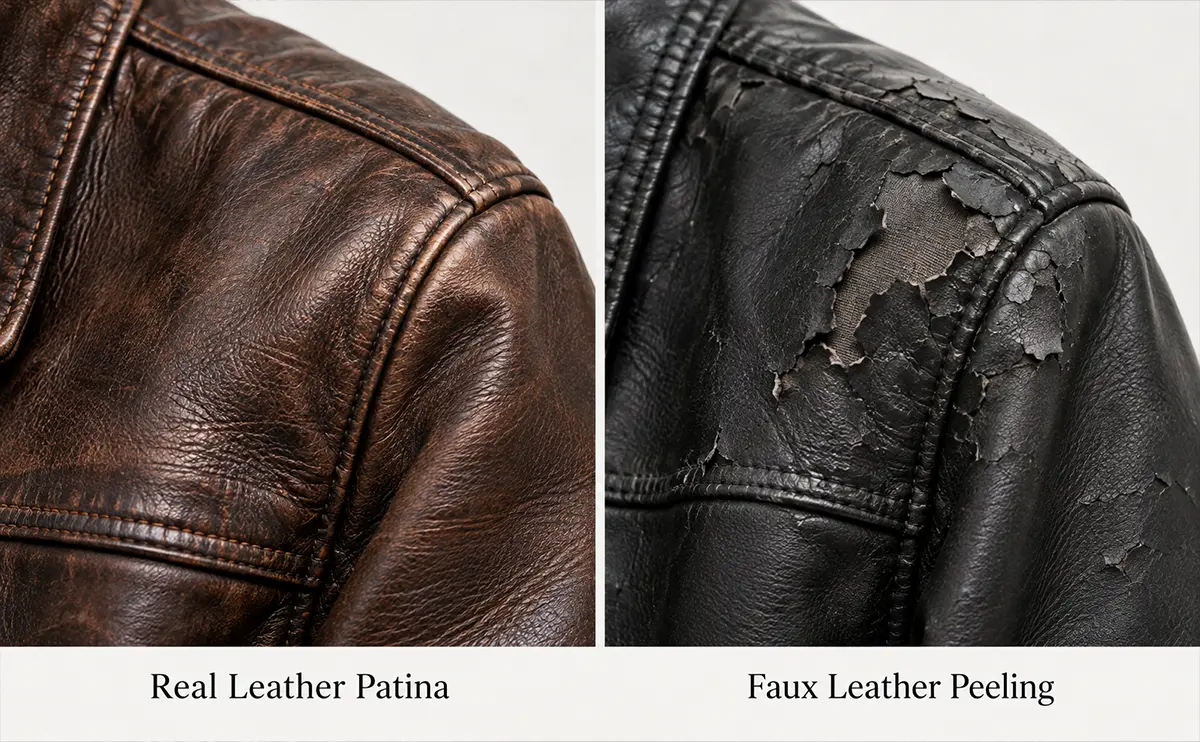
Durability varies heavily with coating quality. In general, faux leather jackets are more likely to show coating failure over time, such as cracking, peeling or delamination, where the surface layer separates from the fabric backing. This tends to appear first at flex and friction points: elbows, cuffs, shoulders, collar and around the pockets. A higher-quality faux leather can hold up well to moderate use, but the failure mode is different from leather. Worn coating generally cannot be repaired in the way a leather surface often can.
We are deliberately not giving a number of years for either material, because lifespan depends on construction, frequency of wear, climate and care.
What this means for buyers
If you want a jacket for frequent, long-term wear, real leather often offers better long-term value. If you want an occasional fashion piece at a lower entry cost, faux leather can make sense. The honest answer to “which lasts longer?” is that real leather often does, but only if it is well made and looked after.
Feel and Comfort
Real leather
Real leather generally feels more natural and substantial. Lambskin can feel very soft from the start. Cowhide can feel firmer at first and tends to soften with use. Because hide is a natural material, texture and flexibility can vary slightly from one area of the jacket to another.
Faux leather
Faux leather is generally more uniform. Depending on quality, it may feel smooth and supple or slightly plasticky. It is often lighter, and breathability can be lower than leather, which may matter in warmer weather or during longer wear.
Comfort is not only about the shell. Lining, cut, layering room and climate all influence how a jacket feels on the body. A well-cut jacket in either material will usually be more comfortable than a poorly cut one in the “better” material. For sizing questions, see our Leather Jacket Fit Guide.
Appearance
Real leather
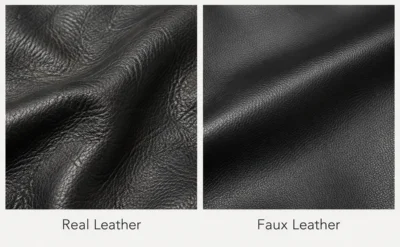
Real leather shows natural grain variation. Panels cut from different parts of a hide can look subtly different, and the texture looks more organic. The surface can also shift with wear, which many people see as part of the appeal.
Faux leather
Faux leather tends to look cleaner and more consistent because the grain pattern is embossed and repeated. From a distance, and especially when new, a good faux leather jacket can look convincing. Up close, the repeating pattern and more uniform surface can be easier to spot, but that is not always the case, and it would be wrong to say faux leather always looks fake.
Aging and Patina
Patina is the change a leather surface goes through with use. In practice it can mean softening, darkening, gentle creasing, subtle shifts in sheen and a more individual surface. How much patina develops, and how it looks, depends on the leather type and finish. Heavily coated or pigmented leathers show less of it than natural, lightly finished ones.
Real leather can develop patina. Faux leather does not develop true leather patina. Instead, wear in faux leather usually shows up as abrasion, scuffing, cracking, peeling or loss of the surface coating, depending on quality.
This is one of the biggest philosophical differences between the two. Real leather changes with age, and many buyers choose it for exactly that reason. Faux leather usually wears rather than develops character, and many buyers prefer it for the opposite reason: it looks the same until it doesn’t.
Maintenance and Care
Real leather
Real leather generally benefits from:
- gentle cleaning with a method suited to the finish
- occasional conditioning where appropriate for that leather
- avoiding prolonged moisture and direct heat
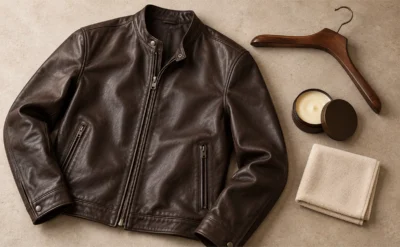
- proper storage on a suitable hanger in a ventilated space
Different finishes need different care, so check the product’s care guidance. Our Leather Jacket Care Guide covers this in more detail.
Faux leather
Faux leather is often easier day to day. A light wipe with a soft, slightly damp cloth is commonly enough for surface dirt. It does not need traditional leather conditioner. Even so, it should be kept away from excessive heat, and harsh cleaners or solvents can damage the coating.
Whichever material you choose, avoid improvised home remedies. When in doubt, follow the care label or ask the seller.
Water Behavior and Rain
Neither material should be treated as waterproof unless the product specifications say so.
Real leather may resist light moisture depending on its finish, but it is not inherently waterproof. Prolonged soaking can leave water marks, stiffen the leather or damage it, particularly if it is then dried too quickly or near heat.
Faux leather has a synthetic surface that may resist light moisture better in some cases. However, the seams, stitching and fabric backing can still let water in, and not every faux leather jacket is waterproof. Some can also trap moisture against the body because they breathe less.
For both, treat a light shower as manageable and sustained rain as something to avoid. If a jacket will be worn in wet weather often, look for specific product information about water resistance rather than assuming either material will cope.
Weight
Real leather is often heavier, especially cowhide or shearling-lined styles. But thinner leathers such as lambskin can be quite light, so weight depends on hide, thickness, lining and design.
Faux leather is often lighter, though it depends on the thickness of the coating and the backing fabric.
Weight matters for daily wear, travel and layering. A heavy jacket can feel supportive and structured in cooler weather, while a lighter one is easier over a long day or over a sweater. If weight matters to you, check product details and try comparing jackets of similar style, not just similar material.
Price
Real leather is usually more expensive, reflecting the cost of the hide, tanning, grading, cutting, construction and material handling. Faux leather is generally cheaper, partly because it is manufactured in consistent rolls and is easier to cut and produce at scale.
We are avoiding fixed price ranges, because prices vary by brand, style and market. A more useful approach is to judge price alongside intended use, construction quality and expected lifespan, rather than comparing sticker prices alone.
Which One Offers Better Value?
Value is not the same as price.
Real leather may offer stronger long-term value if:
- you will wear the jacket often
- you are willing to care for it
- you plan to keep it for years
Faux leather may offer better value if:
- your budget is limited
- your style changes frequently
- you will wear the jacket occasionally
- you prefer to avoid animal-derived materials
If you buy a lower-priced jacket you will love for a season or two, it may be good value for you. If you buy a higher-priced jacket you will wear for many years, it may be too. The conclusion depends on your use, not on the material alone.
Environmental Considerations
This is a topic where simple answers are usually wrong. Neither material is automatically the more sustainable one, and comparing them properly takes product-specific lifecycle data, which is rarely available to the shopper.
Real leather raises questions about:
- animal agriculture and whether hides are treated as a by-product
- tanning methods and chemical use
- water and energy use
- how long the jacket lasts, since a longer-lived garment spreads its impact over more wear
Faux leather raises questions about:
- petroleum-based polymers
- manufacturing processes
- microplastic or shedding concerns where relevant
- shorter lifespan in some products, which can mean earlier replacement
- reduced use of animal-derived material
Newer bio-based or “plant-based” leather alternatives are worth a mention. Many still use synthetic binders or coatings, so “plant-based” does not automatically mean plastic-free or low-impact. Look for specific information on what the material is made of.
If environmental impact is important to you, look for brand-level transparency on materials and manufacturing, and consider how long you are likely to keep the jacket. We do not make an environmental ranking here, because the evidence does not support a universal one.
Is Faux Leather Vegan?
Most PU and PVC faux leather does not use animal hide, which is why it is often marketed as vegan leather. But there are nuances:
- “Vegan” describes the absence of animal-derived leather. It says nothing about environmental impact.
- Adhesives, dyes, linings or trims can vary by product, so a jacket is not necessarily vegan in every component just because the shell is synthetic.
- If strict vegan certification matters to you, check the manufacturer’s claims and any certification directly.
Which Looks More Premium?
It depends on what you value. Real leather often has a more natural grain, more variation, more visual depth and, over time, more interesting aging. Faux leather can still look polished and convincing, especially when new.
The difference tends to become more noticeable over time and at close range. A faux jacket can look sharp in its first season, while a real leather jacket’s look usually evolves. Neither is a better look in itself; it is a matter of preference.
Which Is Better for Everyday Wear?
Real leather may suit:
- frequent wear
- long-term ownership
- buyers who like aging and patina
Faux leather may suit:
- occasional wear
- a lower budget
- a lighter feel
- trend-focused styling
- buyers avoiding animal leather
If you wear one jacket most days through a season, durability and comfort over time matter more, which often points toward real leather. If the jacket is one of several in rotation, faux leather’s lower cost and lighter weight can make more sense.
Which Is Better for Different Jacket Styles?
For a deeper look at styles, see Types of Leather Jackets. Briefly:
- Biker jackets: Real leather often suits rugged, structured designs, as the material holds shape and takes on character.
- Cafe racer jackets: Both work. Real leather gives a more natural hand, while faux can keep the price lower.
- Bomber jackets: Both are common. Weight and lining matter as much as the shell.
- Puffer jackets: Faux leather is common in fashion-forward versions, while real leather puffers exist at higher price points.
- Varsity jackets: Leather and faux-leather sleeves are both common.
How to Tell Real Leather from Faux Leather
No single home test is definitive, and you should not damage a jacket to find out. Avoid burning, soaking, scratching or cutting. Safer indicators include:
- The product label and material description. This is the most reliable source. Look for specific wording rather than vague terms.
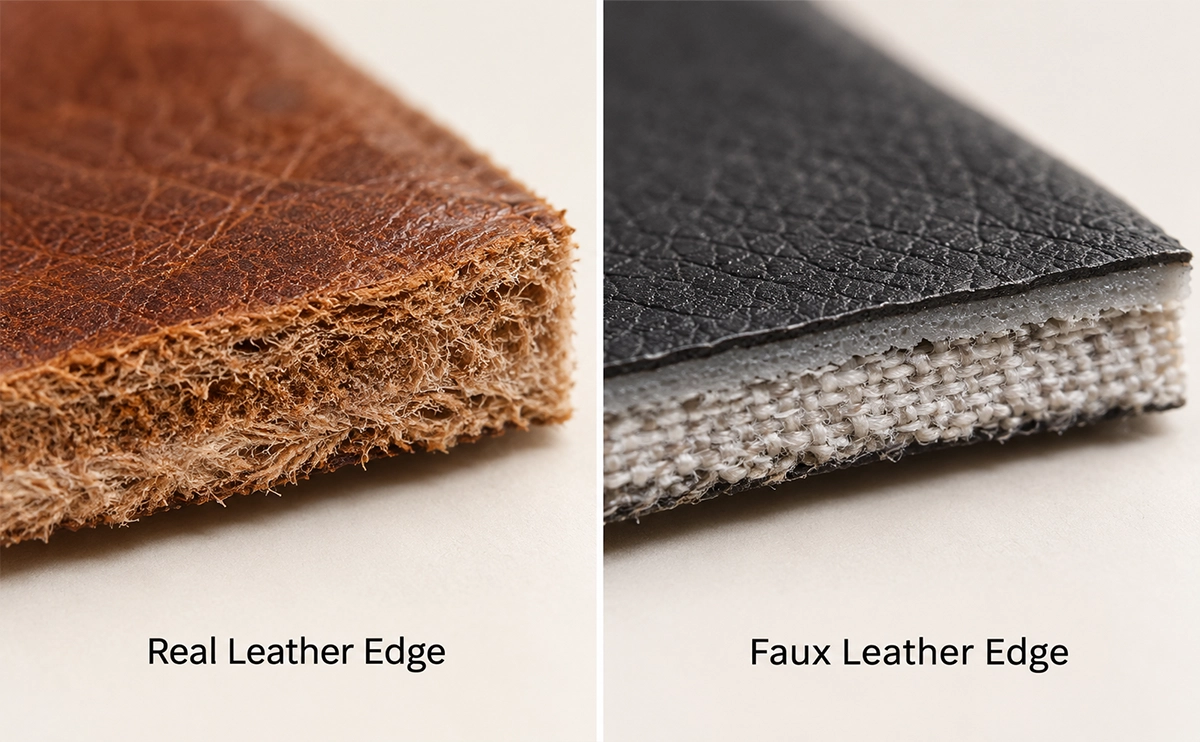
- Edges and cuts. Where visible, real leather typically shows a fibrous edge, while faux leather often shows a fabric backing under a coating.
- Surface grain. Real grain tends to vary. Very regular, repeating patterns suggest embossing.
- Smell. Real leather often has a distinct smell, but this is a weak clue, since treatments and finishes can change it.
- Backing, if visible. Inside seams, hems or linings you may see a woven or knitted backing.
- Seller transparency. A reliable seller states the material clearly and answers questions.
Common Marketing Terms to Understand
- Real leather: made from animal hide.
- Genuine leather: real leather, but not a quality grade by itself. It tells you the material is leather, not how good it is.
- Faux leather: synthetic imitation of leather.
- PU leather: a common type of faux leather with a polyurethane coating.
- Synthetic leather: another term for faux leather.
- Vegan leather: a marketing term for leather alternatives that do not use animal hide. It may still be synthetic.
- Bonded leather: made from leather fibers bonded together, which is not the same as a full leather hide.
Real Leather vs Faux Leather for Different Buyers
| If you want… | Consider |
|---|---|
| Long-term durability | Real leather |
| Lower upfront cost | Faux leather |
| Natural patina | Real leather |
| Animal-free material | Faux leather |
| Easy wipe-clean care | Faux leather |
| More natural texture | Real leather |
| Lighter jacket | Often faux leather |
| Heritage feel | Real leather |
| Occasional fashion use | Faux leather |
| Long-term wardrobe piece | Real leather |
These are tendencies, not guarantees. A well-made jacket in either material can beat a poorly made one in the other.
Real Leather vs Faux Leather: Which Should You Buy?
Choose Real Leather If…
- you want long-term wear
- you value natural grain
- you like patina
- you are comfortable with some maintenance
- you want a heritage-oriented material
Choose Faux Leather If…
- you want a lower upfront price
- you prefer an animal-free material
- you want lighter, trend-focused outerwear
- you prefer simple wipe-clean maintenance
- you plan to wear the jacket occasionally
Final Verdict
Neither material is universally better.
Real leather is generally the better choice for buyers focused on longevity, natural texture, aging and long-term ownership.
Faux leather is often the better choice for buyers focused on lower cost, a lighter feel, animal-free materials, and trend-driven or occasional wear.
The right choice depends on your budget, values, how often you will wear the jacket, how much care you are happy to give it, how long you want it to last, and your style preference. Whichever you choose, check the material description, construction details and care instructions before you buy.
FAQ’s
Not exactly. Faux leather is the broader category, and PU leather is one common type. PVC is another.
Yes, genuine leather is real leather. But the term is not a quality grade on its own, so it does not tell you how good the leather is.
Real leather often lasts longer when well made and cared for, but quality varies in both. Faux leather tends to fail by cracking or peeling, depending on coating quality.
No. Faux leather does not develop true leather patina. Wear usually shows as scuffing, cracking or peeling of the coating.
Not necessarily. Its surface may resist light moisture, but seams and backing can still let water in. Treat a jacket as waterproof only if the product specifications say so.
No. Real leather may resist light moisture depending on finish, but prolonged soaking can stain, stiffen or damage it.
Faux leather jackets are often lighter, but weight depends on thickness, lining and design. Thin real leathers such as lambskin can also be light.
Faux leather is usually easier to wipe clean. Real leather generally needs finish-appropriate cleaning and occasional conditioning.
It can be, especially for lightweight, fashion-focused or occasional-wear jackets. Quality varies, so look at construction and material details.
No. “Vegan” means no animal-derived leather, not low environmental impact. Many vegan leathers are petroleum-based or use synthetic binders.
Yes, particularly at flex points such as elbows, cuffs and shoulders, and especially in lower-quality products.
It can be if you will wear the jacket often, care for it and keep it for years. For occasional wear or a tighter budget, faux leather may be better value.