
Blog

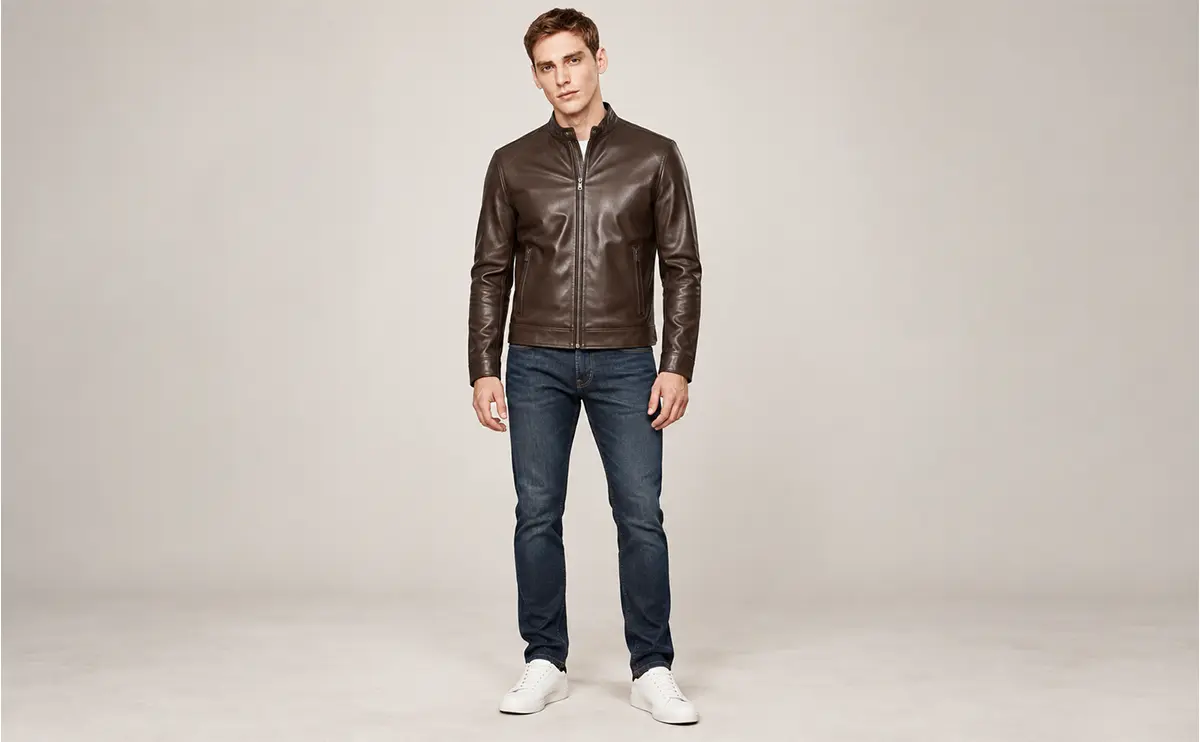
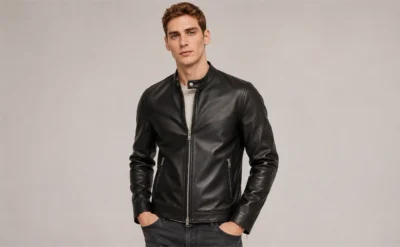
A traditional leather jacket should sit cleanly across the shoulders, follow the torso without pulling, zip comfortably and allow normal arm movement. The sleeves usually finish around the wrist, while the correct length depends on the style. A biker or cafe racer normally fits closer to the body than a bomber, a flight jacket or an intentionally oversized design.
Snug does not mean restrictive. A well-fitted leather jacket should feel shaped and secure, but it should not:
- pull hard at the zipper
- dig into the armpits
- restrict your breathing
- stop you from moving your arms normally
- create severe tension across the upper back
Fit also isn’t one fixed rule. A slim cafe racer and an oversized fashion jacket can both fit correctly even though their proportions are very different. What matters is whether the jacket fits as the design intends. This guide shows you how to judge that, how to measure yourself, and how to choose a size with confidence when you can’t try the jacket on first.
If you’re still deciding which style suits you, our Complete Leather Jacket Guide covers types, leather and styling. This article focuses purely on size and fit.
Leather Jacket Fit at a Glance
Use this table as a quick reference. Each row describes a traditional fitted or regular-fit jacket.
| Area | Good Fit | Too Tight | Too Loose |
|---|---|---|---|
| Shoulders | Seam sits close to the intended shoulder line | Pulling across the upper back | Seam drops far down the arm, shoulders collapse |
| Chest | Close but comfortable when zipped | Zipper strains, chest feels compressed | Excess material, ballooning |
| Sleeves | End around the wrist, depending on style | Ride sharply up the forearm when you move | Cover much of the hand |
| Waist | Follows the intended silhouette | Hem or zipper pulls and rides up | Loose fabric around the torso |
| Length | Matches the jacket’s style | Looks unintentionally cropped | Overwhelms the intended shape |
| Mobility | Reaching and bending feel normal | Pain or severe restriction | Jacket shifts excessively |
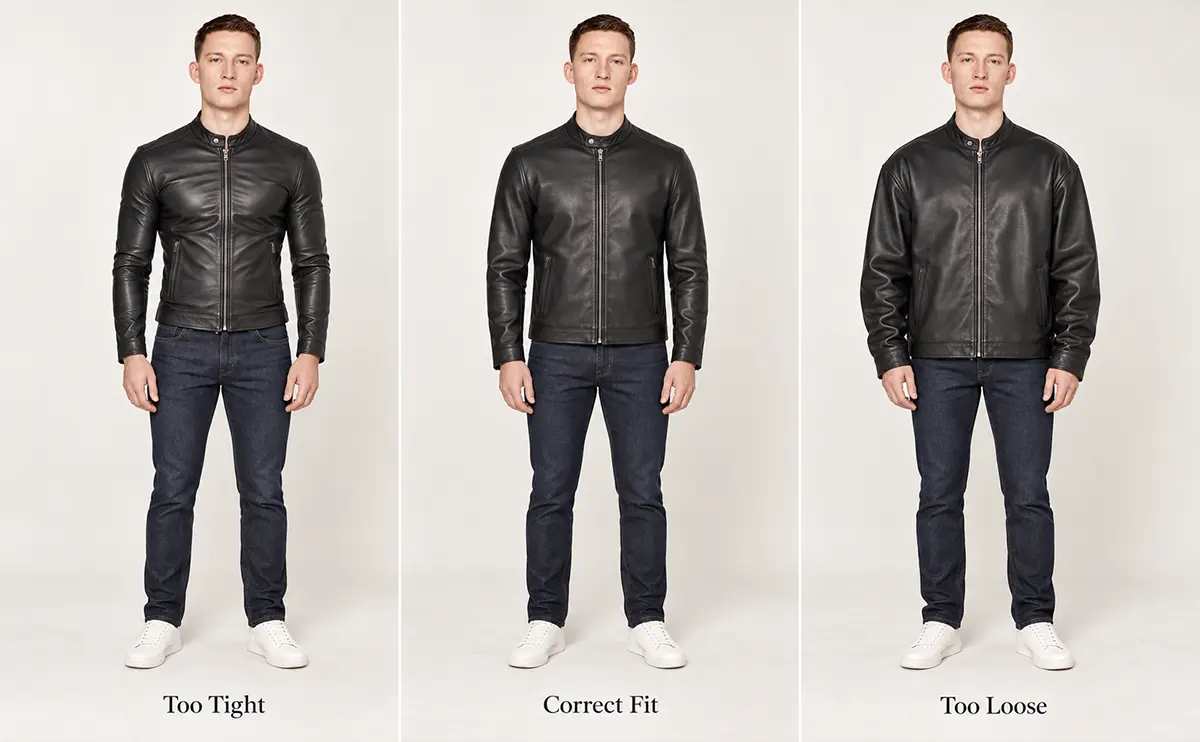
Intentionally oversized jackets are an exception to several of these rules. They are covered separately below.
Should a Leather Jacket Be Tight or Loose?
A traditional fitted leather jacket should generally be snug rather than tight. The difference matters.
Snug means:
- the jacket follows your body with little unnecessary fabric
- it zips comfortably
- you can move normally
- it looks structured
Too tight means:
- the zipper visibly strains
- you see strong horizontal pulling across the chest or back
- your shoulders feel compressed
- the underarms dig in
- breathing feels restricted
- reaching forward becomes difficult
Too loose means:
- there’s excessive material around the torso
- the shoulders collapse when they shouldn’t
- the sleeves swallow your hands
- the jacket shifts around as you move
- the silhouette looks larger than the design intends
Oversized styles behave differently by design. If you want that look, jump to the oversized section.
Start With the Shoulders
If you can only get one area right, make it the shoulders. They are the foundation of the jacket’s structure, and they’re the hardest area to change later.
On a traditional fitted jacket:
- The shoulder seam should generally sit close to the natural edge of your shoulder.
- A very slight drop can be intentional, depending on the pattern.
- A seam sitting well down the upper arm often means the jacket is too large, unless the design is oversized or dropped-shoulder.
- A seam sitting noticeably inward, combined with pulling across the upper back, usually means there isn’t enough room.
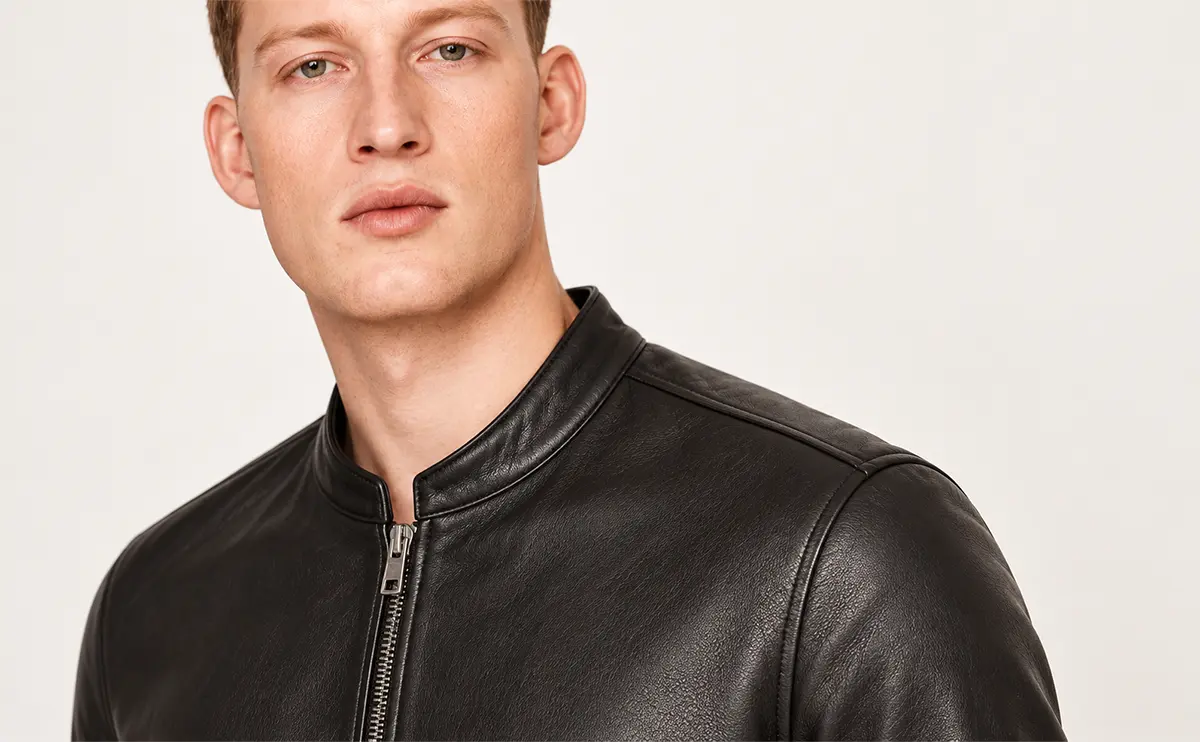
Not every jacket should place the seam at exactly the same point. Vintage-inspired, relaxed and oversized patterns all vary. Judge the shoulders against the intended silhouette, not a single anatomical landmark.
Because major shoulder alterations are difficult in leather, shoulder fit should usually take priority over smaller issues like sleeve length or waist width.
How Should the Chest Fit?
Always judge the chest fully zipped, even if you plan to wear the jacket open. A jacket that only feels right unzipped is often too small.
A correct chest fit should:
- close without forcing the zipper
- allow normal breathing
- let your arms move forward
- keep a clean silhouette
- avoid large amounts of empty fabric
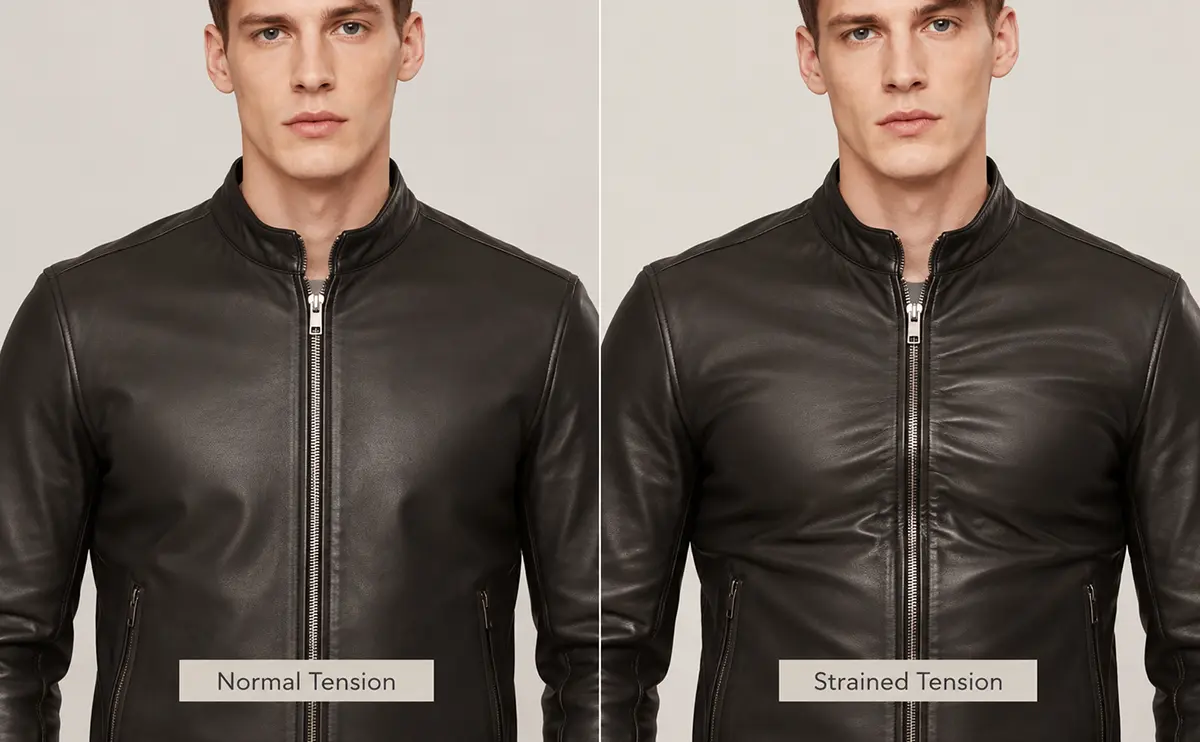
Signs the chest is too tight:
- the zipper forms severe waves
- material pulls strongly from the zipper toward the armpits
- the upper back feels restrictive
- the chest feels compressed
- the front panels or lapels distort
Signs it is too loose:
- large folds of unused material
- the torso balloons outward
- the jacket loses its intended shape
How Should the Waist Fit?
Waist fit depends heavily on the style.
- Cafe racer: usually clean and close through the torso.
- Biker: often fitted or slightly tapered.
- Bomber: usually more torso room, finished with a fitted ribbed waistband.
- Flight or aviator: may have extra room for warmth and layering.
- Oversized: may intentionally have considerable volume.
Whatever the style, a correctly fitting jacket should not ride dramatically upward when zipped. If the hem lifts every time you raise your arms or sit, the torso or hip is likely too tight for that pattern.
How Long Should Leather Jacket Sleeves Be?
For many fashion leather jackets, the sleeve ends around the wrist bone. Finishing slightly below the wrist can also be normal. What you want to avoid is cuffs that swallow most of your hand, or sleeves that expose a large part of the forearm.
Riding-inspired jackets may deliberately use longer sleeves, because arms extend forward on a motorcycle and the sleeve needs to stay covered in that position. If a jacket is designed that way, a slightly longer sleeve at rest is intentional.
Sleeve movement test:
- Stand with your arms relaxed.
- Bend both elbows.
- Reach forward as if holding a steering wheel.
- Check how far the sleeves pull back.
The sleeves should stay functional through ordinary movement. If they ride high up the forearm, the sleeve or armhole may be too short or too tight.
Sleeve length is also one of the areas a leather specialist can sometimes adjust, which is another reason not to sacrifice shoulder fit to fix it.
How Long Should a Leather Jacket Be?
There is no single correct hem position. Judge length against the intended design, not a universal belt-line rule.
- Biker jacket: often waist to upper-hip length.
- Cafe racer: commonly around the waist or upper hip.
- Bomber: usually finishes around the waist or high hip, because of the ribbed hem.
- Aviator / flight jacket: may sit slightly lower.
- Field jacket: often extends below the hip.
- Leather blazer: follows blazer proportions.
- Leather trench coat: intentionally much longer.
A jacket looks “too short” or “too long” mainly when it differs from how that style is meant to look, or when it changes the proportions you were expecting.
How Should the Back Fit?
The back is often overlooked, but it’s where tightness shows up first when you move.
When you stand naturally:
- the back should look relatively clean
- some folds are normal
- the leather should not form severe tension lines
When you reach forward:
- some tension across the back is expected
- the jacket should still allow reasonable movement
Signs of insufficient upper-back room:
- strong horizontal pulling
- shoulders pushed forward
- difficulty reaching comfortably
- armholes digging in
Test Mobility Before Deciding the Size
Standing still in front of a mirror hides most fit problems. Try this five-step test:
- Zip the jacket completely.
- Reach both arms forward as if holding a steering wheel.
- Raise your arms to roughly shoulder level.
- Bend both elbows.
- Sit down with the jacket still zipped.
A correct fit may feel structured, especially in firm leather. It should not cause pain, severe pulling, restricted breathing, or excessive pressure in the shoulders or underarms.
One note: these tests are for fashion jackets. Certified motorcycle protective clothing has its own fit and movement requirements. A fashion biker jacket is not a substitute for protective riding gear.
Should a New Leather Jacket Feel Tight?
A new jacket can feel firm, structured and close-fitting, especially if it’s made from thicker leather. That’s normal.
But it shouldn’t depend on dramatic future stretching to become wearable.
Do not buy a jacket that is genuinely too small on the assumption that it will stretch into the correct size. Leather can soften and relax with wear, but it does not reliably turn an incorrect size into the right one.
Does a Leather Jacket Stretch Over Time?
Real leather can:
- soften
- relax slightly
- conform to your movement patterns
- become more comfortable around the elbows, shoulders and torso
But how much varies. Thickness, tanning, hide type, lining and construction all limit the change. A leather jacket should not be expected to stretch “a whole size.”
Hide type matters. Cowhide often begins firmer, while lambskin generally starts softer and more supple. For a deeper comparison, see our cowhide vs lambskin leather jackets guide.
How to Measure Yourself for a Leather Jacket
Use a flexible cloth measuring tape, stand naturally, and wear thin clothing. Ask someone to help if you can, since a few of these measurements are difficult to take alone.
Chest / Bust
Measure around the fullest part of your chest or bust. Keep the tape level, close to the body and not compressing.
Natural Waist
Measure around your natural waist, or the point specified by the retailer’s size chart. Brands may define the waist differently, so check the chart.
Shoulders
Measure across the back from one shoulder point to the other. This is easiest with another person.
Sleeve Length
Brands measure sleeves differently, so follow the specific retailer’s method. Common methods include:
- shoulder point to wrist
- center back neck to wrist
These are not interchangeable. Using the wrong method can produce a significantly different number.
Jacket Length
Measure from the high shoulder point down to where you’d like the hem to fall.
Hips
Useful for longer jackets, women’s fitted cuts and any style that extends over the hip.
Body measurement checklist
| Measurement | How to take it | Why it matters |
|---|---|---|
| Chest / bust | Fullest point, tape level | Primary size driver |
| Waist | Natural waist | Torso and hem fit |
| Shoulders | Shoulder point to shoulder point | Hardest area to alter |
| Sleeve | Follow the retailer’s method | Cuff position |
| Length | High shoulder point to hem | Style proportions |
| Hips | Fullest point | Fitted and longer cuts |
Body Measurements vs. Jacket Measurements
This is one of the most common online-shopping mistakes.
- Body measurement is the measurement of you.
- Garment measurement is the measurement of the jacket itself.
A 40-inch chest does not necessarily mean the jacket should measure exactly 40 inches. Patterns include ease, the extra room built in for movement, lining, intended silhouette and layering.
Before you compare numbers, check whether the size chart lists:
- body dimensions, or
- finished garment dimensions
If a chart doesn’t say, ask the retailer before ordering.
How to Measure a Jacket You Already Own
If you already own a jacket that fits well, it’s one of the most reliable references you have. Lay it flat and measure:
- pit to pit (across the chest, armpit to armpit)
- shoulders
- sleeve
- back length
- waist width, where relevant
Be careful not to double every measurement automatically. A flat chest measurement needs doubling to compare with a circumference, but only if the product chart lists circumference. Methodology varies by retailer, so check how the chart’s numbers are defined before comparing.
What If You Are Between Sizes?
Don’t default to “always size up.” Work through these questions instead:
- Which of your measurements is closest to the limit of each size?
- Is the jacket meant to be fitted or relaxed?
- What will you wear underneath?
- Is the leather soft or structured?
- Does the product page list garment measurements?
Then prioritize, in this order:
- Shoulders
- Chest / bust
- Mobility
If the shoulders fit but the jacket is slightly long in the body, that’s usually easier to live with than a jacket that’s right in the body and too narrow across the shoulders.
Should You Size Up for Layering?
It depends on what you actually wear underneath.
If you usually wear the jacket over a T-shirt, shirt or lightweight knit, your normal intended size may be appropriate.
If you regularly wear it over a thick sweater, substantial hoodie or multiple winter layers, you may need extra room.
A useful approach: if possible, measure yourself while wearing your typical layer, since that reflects real use. Don’t automatically go up a full size, because that can ruin shoulder fit and proportions. Consider a relaxed-fit or roomier style instead.
Slim Fit vs. Regular Fit vs. Relaxed Fit vs. Oversized Fit
| Fit | Silhouette | Layering | Typical Feel |
|---|---|---|---|
| Slim | Close to the torso | Limited | Sharp and fitted |
| Regular | Shaped with moderate ease | Light layering | Balanced |
| Relaxed | More room through the body | Easier | Casual |
| Oversized | Deliberately large proportions | High | Fashion-forward |
- Slim: a streamlined cut. Best if you wear light layers and want a sharp outline.
- Regular: the most versatile. Shaped, but with enough ease for a shirt or light knit.
- Relaxed: more room in the chest and body. Comfortable and easier to layer.
- Oversized: large proportions on purpose, built into the pattern rather than created by simply choosing a bigger size.
How Should an Oversized Leather Jacket Fit?
Oversized does not simply mean buying a fitted jacket several sizes too large.
A properly designed oversized jacket may intentionally include:
- dropped shoulders
- wider sleeves
- more chest room
- longer sleeve proportions
- extended body length
- deliberate volume
If you buy a standard fitted pattern several sizes up, you can distort the armholes, sleeves, hem and overall proportions. The jacket can end up looking sloppy rather than intentionally big.
If the look you want is oversized, choose a jacket designed as oversized.
How Should a Biker Leather Jacket Fit?
A classic fashion biker jacket generally looks best when it is:
- fairly close through the shoulders and chest
- structured
- relatively cropped
- able to zip without strain
It should still allow normal arm movement. Asymmetric double-rider styles can behave differently when zipped, since the front panel overlaps and the closure sits off-centre, so check how they feel fully closed.
A fashion biker jacket is not automatically motorcycle protective gear. If you ride, look for certified protective equipment. If you prefer a close, structured motorcycle-inspired silhouette, explore our Men’s Biker Jackets.
How Should a Cafe Racer Jacket Fit?
Cafe racers usually benefit from:
- a clean shoulder line
- a streamlined chest
- a relatively close torso
- minimal excess material
- a straight front zipper
- a clean waist
The goal is a slim, streamlined silhouette without restricting normal movement. Because the cafe racer has such a clean, minimal construction, small sizing errors tend to show more clearly than they do on roomier jacket styles.
For a deeper look at the design, including its motorcycle origins, band collar, materials, fit and styling, read our What Is a Cafe Racer Jacket? guide. If you already know this is the style you want, explore our Men’s Cafe Racer Jackets.
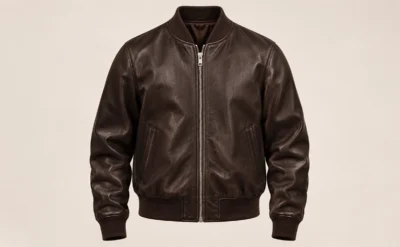
How Should a Leather Bomber Jacket Fit?
Bomber jackets are generally:
- roomier through the chest
- less sharply tapered
- structured by ribbed cuffs and a ribbed waistband
- easier to layer
The ribbed hem should sit cleanly without extreme bunching. Don’t judge a bomber by cafe-racer standards: a bomber that looks loose beside a slim cafe racer may be fitting exactly as designed. For more detail on bomber construction, MA-1 and flight-jacket origins, materials, variations and styling, read our Complete Bomber Jacket Guide. If you’re ready to shop, explore our Men’s Bomber Jackets.
How Should an Aviator or B-3 Shearling Jacket Fit?
These styles often have:
- greater torso volume
- room for insulation
- thicker collars or shearling
- more layering capacity
A B-3 or shearling-inspired silhouette can look substantially bulkier than a lightweight cafe racer and still fit correctly. Judge it by the pattern’s intended proportions: the shoulders should still look right and the jacket should still move with you.
How Should a Men’s Leather Jacket Fit?
Men’s patterns often feature a straighter torso, broader shoulder proportions and longer sleeve and body blocks. These are pattern tendencies, not universal rules, and bodies vary a great deal.
Instead of assuming, focus on the same fundamentals:
- shoulders
- chest
- waist
- sleeve
- the intended silhouette
If you’re comparing sizes across different cuts, browse our Men’s Leather Jackets to see cafe racer, biker, bomber, aviator and other silhouettes side by side.
How Should a Women’s Leather Jacket Fit?
Some women’s patterns include:
- bust shaping
- a narrower waist
- additional hip shaping
- cropped proportions
- curved seams
Rather than choosing by “body type,” check the fit points:
- the bust should not distort the zipper
- the shoulders should look clean
- waist shaping should align naturally with your waist
- the hem should not flare or ride up unintentionally
Not every woman will fit a women’s pattern best, and many people prefer a different cut. Use the measurements and the garment dimensions, not the label.
How Leather Type Changes the Fit
Cowhide is usually firmer and more structured, and may need more break-in time. It tends to hold its shape.
Lambskin is usually softer and more supple, and conforms more easily from the start.
Other factors also affect how a jacket feels and fits: thickness, finish, tanning method and lining. Two jackets in the same size can feel noticeably different depending on these. Our cowhide and lambskin comparison explains the differences in more detail.
Signs Your Leather Jacket Is Too Small
- you can’t zip it comfortably
- the zipper pulls sharply
- you see severe horizontal tension lines
- the shoulders feel compressed
- the upper back restricts reaching
- the underarms pinch
- breathing feels restricted
- the hem repeatedly rides upward
- the sleeves pull excessively during normal movement
One minor crease on its own isn’t evidence of a poor fit. Look for a pattern of problems, especially while you’re moving.
Signs Your Leather Jacket Is Too Big
- the shoulder line hangs excessively, unless the style is intentionally oversized
- the chest contains large amounts of unused volume
- the torso collapses or balloons
- the sleeves cover much of your hand
- the jacket shifts substantially as you move
- the hem and body look unintentionally long
- the silhouette loses the design’s intended shape
Again, an intentionally oversized jacket will show some of these on purpose. The question is whether the result looks designed or accidental.
Common Leather Jacket Sizing Mistakes
- Buying by S/M/L alone. Sizes vary by brand and design.
- Assuming your usual clothing size will match. Use actual measurements.
- Sizing too small because “leather stretches.” Leather relaxes only modestly.
- Sizing up automatically. This can ruin the shoulders and proportions.
- Ignoring the intended fit. Slim, bomber and oversized jackets shouldn’t fit identically.
- Only trying the jacket open. Always test it zipped.
- Ignoring layering. Try it with realistic clothing underneath.
- Ignoring movement. Standing still isn’t enough.
- Confusing garment and body measurements. Remember ease.
- Prioritizing sleeve length over shoulders. Sleeves can sometimes be altered; shoulders are far harder.
30-Second Leather Jacket Fit Test
Ask yourself:
- Do the shoulders align with the intended silhouette?
- Can the jacket zip comfortably?
- Can you breathe normally?
- Can you reach forward?
- Can you bend your elbows?
- Do the sleeves finish near the intended wrist position?
- Does the hem match the jacket style?
- Is there room for your normal layers?
- Are there strong tension lines?
- Does the jacket still look balanced from the back?
If most answers are yes, the size is probably close to correct.
How to Choose Your Size When Shopping Online
Step 1: Open the specific product’s size chart. Don’t rely on a generic chart or a size from another brand.
Step 2: Find out whether it lists body or garment measurements. This changes how you read every number.
Step 3: Measure yourself. Chest or bust, waist, shoulders, sleeves, and hips if relevant.
Step 4: Compare your measurements with the product chart.
Step 5: Consider the intended fit. Slim, regular, relaxed or oversized.
Step 6: Consider layers. What will you actually wear underneath?
Step 7: Compare with a jacket you already own, if the product page lists garment measurements.
Step 8: If you’re still between sizes, prioritize the dimensions hardest to alter, especially shoulders and chest.
Leather Jacket Fit by Style: Quick Comparison
| Jacket Style | Typical Torso Fit | Typical Length | Layering Room |
|---|---|---|---|
| Biker | Close / structured | Waist to upper hip | Low to moderate |
| Cafe Racer | Slim / streamlined | Waist to upper hip | Low to moderate |
| Bomber | Regular / relaxed | Waist / high hip | Moderate |
| Aviator | Regular / roomy | Waist to hip | Moderate to high |
| Shearling / B-3 | Roomy / substantial | Waist to hip | Moderate |
| Blazer | Tailored | Longer | Low to moderate |
| Oversized | Intentionally loose | Varies | High |
Individual patterns vary. Always check the specific product’s measurements.
Fit is only one difference between these silhouettes. If you’re specifically choosing between the two slimmer motorcycle-inspired styles, our Biker Jacket vs Cafe Racer Jacket comparison explains their differences in collars, closures, hardware, fit and overall appearance.
Which Areas Matter Most If the Fit Is Not Perfect?
If you have to compromise, prioritize in this order:
- Shoulders
- Chest / bust
- Upper-back mobility
- Waist / torso
- Sleeve
- Hem length
Sleeve length and some waist adjustments may sometimes be possible, while substantial shoulder changes are usually far more difficult. Not every leather jacket can be altered easily, and any work should be done by a specialist leather tailor rather than a general alterations shop.
Once the jacket fits properly, our Leather Jacket Care Guide: Cleaning, Conditioning & Storage explains how to keep it clean, conditioned, dry and correctly stored.
Final Buying Checklist
Before you order, ask yourself:
- Have I checked the product-specific size chart?
- Does it show body or garment measurements?
- Have I measured my chest or bust?
- Have I measured my shoulders?
- Have I checked sleeve length and the retailer’s method?
- Do I know the intended fit?
- Will I wear thick layers underneath?
- Am I relying on leather stretching to fix a bad size?
- Is this jacket meant to be slim, regular, relaxed or oversized?
- Can I compare measurements with a jacket I already own?
Which Leather Jacket Fit Should You Choose?
Choose a slim fit if you want a sharp silhouette, normally wear light layers and prefer cafe racer or fitted biker styles.
Choose a regular fit if you want versatility, need modest layering room and want a classic everyday jacket.
Choose a relaxed fit if comfort and layering matter more to you, or you prefer bomber or flight styles.
Choose an oversized fit if you’re deliberately after streetwear proportions, want dropped shoulders and volume, or plan to layer heavily.
Final Verdict
The best leather jacket fit is set by the design, not by one universal measurement rule.
For a traditional fitted jacket:
- the shoulders should look intentional
- the chest should close without strain
- the sleeves should finish around the wrist
- the torso should follow the body without squeezing
- movement should stay comfortable
Never rely on dramatic future stretching to correct the wrong size. The right size should already feel wearable when new.
When you’re ready to compare styles and sizes:
Shop → Men’s Leather Jackets
Shop → Women’s Leather Jackets
FAQ’s
It should sit cleanly across the shoulders, zip without strain, follow your torso without pulling, and let you move normally. Sleeves usually end around the wrist, and length depends on the style.
For a traditional fitted jacket, snug rather than tight. It should feel structured without restricting breathing or movement. Relaxed and oversized styles are intentionally looser.
Not automatically. Size up only if your measurements, intended fit or layering needs call for it. Sizing up can distort the shoulders and proportions.
No. Leather can soften and relax modestly, but it won’t reliably turn a too-small jacket into the right size.
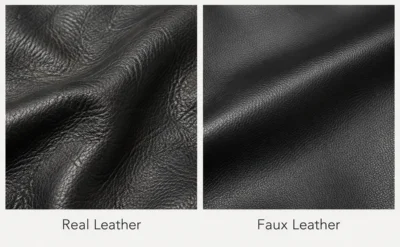
Real leather can soften, relax slightly and conform to repeated movement, but that change is limited and varies by hide, thickness, tanning and construction. Faux leather behaves differently because its surface is a synthetic coating rather than animal hide. If you’re deciding between the two materials, read our Real Leather vs Faux Leather Jackets comparison.
On a traditional fitted jacket, the seam should sit close to the natural shoulder edge without pulling across the back. Oversized and dropped-shoulder designs differ by intent.
Usually around the wrist, sometimes slightly below. Riding-inspired designs may be intentionally longer. The cuffs shouldn’t cover most of your hand.
It depends on the style. Biker and cafe racer jackets often sit at the waist or upper hip, bombers finish at the ribbed hem around the waist or high hip, and field jackets and trench coats run longer.
Yes, comfortably. If the zipper strains or creates severe waves, the chest or torso is probably too tight.
Fairly close through the shoulders and chest, structured, relatively cropped, and able to zip without strain while still allowing normal arm movement.
Prioritize shoulders, chest or bust, and mobility. Consider the intended fit, your usual layers and whether the product lists garment measurements.
Sometimes. Sleeve and some waist adjustments may be possible, but major shoulder changes are difficult. Use a specialist leather tailor.